July 2026
Tracing lion’s decline through the bones of Roosevelt expeditions
“But the lions now offer, and have always offered, the chief source of unpleasant excitement.” by Theodore Roosevelt (African Game Trails, 1910).
A stronghold under pressure
The lion was once among the most widespread large carnivores on Earth, ranging from the Cape of Good Hope to the Mediterranean and from West Africa to India. Today the species survives only in western India and Sub-Saharan Africa, and African populations have fallen dramatically over the last several decades, with an estimate of 20,000 to 25,000 individuals left [1]. Nevertheless, East Africa is still described as a modern lion stronghold, home of many of the continent’s largest populations [2]. A central question in conservation efforts of the lion species is how much of the genetic diversity and connectivity we see today reflects a truly healthy situation, and how much is already an eroded version of something richer that existed decades ago. To answer that though, we require a window into the past, something that museum collections can provide.
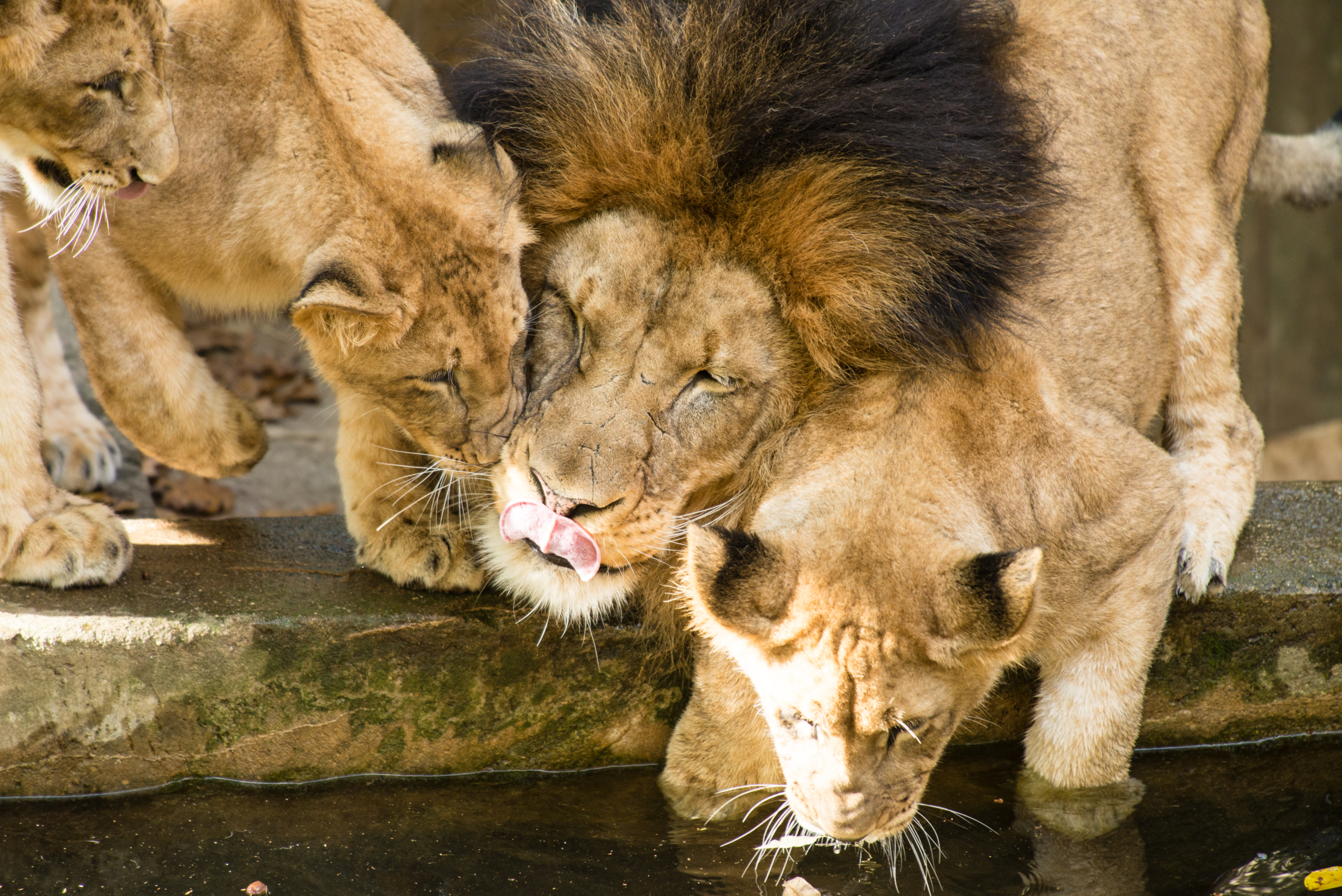
African lions drinking in a pond. Photo by Connor Mallon, Smithsonian's National Zoo.
Bones and skins that carry a genome
Our AaRC speaker, Dr. Michael Campana and his team made use of one such window in a direct way [3]. During the Smithsonian-Roosevelt East African Expedition of 1909 to 1911 and the Rainey Expedition of 1911 to 1912, thousands of lion specimens were collected from what is now Kenya and neighboring regions, and many of these have sat in the collections of the National Museum of Natural History ever since. The team sampled still attached soft tissue and previously damaged bone from these specimens. In doing so, the authors managed to generate whole-genome data from 45 historical Kenyan lions from the Roosevelt and Rainey collections, added newly sequenced genomes from 94 recent Kenyan and Tanzanian lions, and combined everything with all publicly available East African sequence data. The final dataset came to 100 recent genomes, mostly from 1985 to 1999, and 102 historical genomes spanning 1896 to 1946. However, working with material this degraded is never clean or overly efficient, resulting in most historical genomes being sequenced at very low depth. To circumvent this, the team led by Dr. Campana leaned on genotype-likelihood methods rather than hard genotype calls.
What the genomes revealed
Two signals came through clearly. First, principal component analysis and admixture modelling consistently separated recent Tanzanian lions, mostly from the Serengeti, from recent Kenyan lions, mostly from Tsavo East. When the historical individuals were added, they filled in a north-south cline between these two modern clusters, with historical Kenyan and Tanzanian lions sitting closer together than their present-day counterparts do. In other words, populations that a century ago were probably connected and interbreeding one another, now sit as more distinct, fragmented and isolated groups. A separate group was formed by three lions from the Aberdare mountain range, consistent with earlier evidence that this upland population is genetically distinctive [4]. The second signal is diversity loss. Recent East African lions were significantly more inbred than their historical counterparts, and the three deep-sequenced Roosevelt lions were significantly more heterozygous than recent Kenyan lions. Campana’s team also saw an accumulation of runs of homozygosity in recent genomes, although they treat that particular finding as suggestive rather than settled. The mitochondrial phylogeny, by contrast, showed widespread sharing of haplotypes across the continent and only shallow divergence, a reminder that maternally inherited markers can miss the fragmentation that whole genomes may identify [5].
A historical bottleneck with a name
Perhaps the most striking result is demographic. When the authors reconstructed effective population sizes for the Serengeti-Mara and Tsavo populations, they found a rapid decline beginning roughly 25 generations ago in both. At a lion generation time of about five years, that places the bottleneck in the late XIX century, coinciding with the great rinderpest panzootic that swept East Africa in the 1890s [6] and is estimated to have wiped out roughly 90% of the cattle and wild bovids in the region, with predators declining as their prey collapsed. Effective population size in Kenya was much larger, around 3,500, than in Tanzania, around 1,500, before the rinderpest bottleneck, while current effective sizes tell a sobering story, with only roughly 202 for the Serengeti-Mara and about 12 for Tsavo [3].
Why old skins still matter
Reading genomes from lions shot more than a century ago, then laying them directly against lions alive today, is an experiment that no amount of modern sampling could reproduce on its own. Modern populations carry the fingerprints of twentieth-century management, the fences, the culls, the relocations between reserves… so diversity estimates measured now can quietly mislead us about what is natural and what is recent damage. The Roosevelt and Rainey specimens predate almost all of that, and they are a baseline collected before modern interventions rearranged the whole lion’s habitat. By showing that early twentieth-century East African populations were more connected than they are now, the research led by Dr. Campana is a reminder that current translocations that move animals between isolated groups are unlikely to be harmful, and may help rebuild the gene flow that once existed naturally [7]. More than that, museum collections assembled for reasons that have nothing to do with genomics, in this case a former president’s hunting expedition, can become some of our most powerful instruments for measuring how much has changed in relatively few years to better inform what to do next about it.
References
- Bauer, H. et al. Lion (Panthera leo) populations are declining rapidly across Africa, except in intensively managed areas. Proc Natl Acad Sci USA. 112, 14894–14899 (2015).
- Nicholson, S. K. et al. Socio-political and ecological fragility of threatened, free-ranging African lion populations. Commun Earth Environ 4, 302 (2023).
- Armstrong, E. E. et al. President Roosevelt’s lions reveal a century of population fragmentation in Africa’s largest carnivore. bioRxiv 2025.02.26.640359 (2025).
- Dubach, J. et al. Molecular genetic variation across the southern and eastern geographic ranges of the African lion, Panthera leo. Conservation Genetics 6, 15–24 (2005).
- Curry, C. J. et al. Spatiotemporal Genetic Diversity of Lions Reveals the Influence of Habitat Fragmentation across Africa. Mol Biol Evol 38, 48–57 (2021).
- Sunseri, T. The African Rinderpest Panzootic, 1888–1897. Oxford Research Encyclopedia of African History (2018).
- Bertola, L. D. et al. Genetic guidelines for translocations: Maintaining intraspecific diversity in the lion (Panthera leo). Evol Appl 15, 22–39 (2022).
Below, Michael shared with us further details about his profile, career, prospects and future projects:
1. Briefly introduce yourself. What is your origin story for how you got into science?
I am a conservation genomicist at the Smithsonian’s National Zoo and Conservation Biology Institute. My primary areas of expertise include ancient and non-invasive DNA analyses, bioinformatics, and computational genomics. I have wanted to be a scientist since I was a small child fascinated by dinosaurs. While earning my undergraduate degree in palaeontology, I became interested in ancient DNA analyses and my research career developed from there.
2. How and/or why did you start working on this project?
I am the quintessential “cat person”. In 2014, I was recruited to work on the Roosevelt Resurvey project being led by Kris Helgen and Rob Fleischer. The opportunity to work on big cats fulfilled a life-long research dream.
3. Were there any major challenges in this project? How did you overcome them?
The first challenge was obtaining sufficient sequence data from the museum specimens for analysis. We started the project well before the advent of cost- effective and time-efficient single-stranded library protocol development. Initially, we were planning on using hybridization capture, but we changed our approach at the urging of Ellie Armstrong (then a PhD student at Stanford University). We upgraded our library preparation protocols over time to accommodate the low-coverage whole genome approach. The second major challenge was limited reference data and genomic parameterization for lions (and big cats in general). We solved the latter problem by generating these data ourselves.
4. What do you think are the main take-home messages of this project?
Analysis of museum specimens is indispensable for effective conservation actions. The genomic patterns observed using only extant samples often give a very misleading picture of what lion diversity “should” look like. Secondly, analysis of non-model organisms (especially non-humans) is surprisingly challenging due to limited genomic resources, even for iconic species such as lions.
5. What do you think is missing in the field that you would like to work on?
The translation of ancient-DNA-based conservation recommendations to effective conservation practice remains limited. Implementing effective conservation is much more challenging than the basic science at this point. Part of the issue is that the basic science is still monopolized by the Global North. To address this, I am helping build conservation genomics capacity in range countries.
6. Where do you see yourself in the near future?
I am planning on continuing my conservation genomics work on a wide range of organisms, including bears, Hawaiian birds, invasive pathogens, dholes, and big cats (among others). One of the best things about working at the zoo is the diversity of projects I get!
7. Free space to tell something you would like to remark.
I never would have predicted the direction my research career would take, even as a graduate student studying ancient DNA. I advise early-career researchers to keep their aspirations open and be willing to adapt to opportunities as they become available.