July 2026
The true life of the American cheetah
*“For animals belonging to two most distinct lines of descent, may readily become adapted to similar conditions, and thus assume a close external resemblance; but such resemblances will not reveal, will rather tend to conceal their blood-relationship to their proper lines of descent.” (Charles Darwin, On the Origin of Species, 1859).
A cat named after a look
Pleistocene North America held a far richer set of big cats than the continent has today: alongside pumas, jaguars, and lynxes, there were American lions, saber-toothed cats, and the lesser-known American cheetah, Miracinonyx trumani. As our AaRC TikTalk speaker Molly Cassatt-Johnstone explained, the animal was described in 1979 and named for its resemblance to the Old World cheetah, Acinonyx [1]. The two shared a sprinter’s build with long front legs, a short muzzle, and enlarged nasal passages for taking in oxygen during a chase. The similarity was such that researchers thought anything other than shared ancestry between both species would be hard to explain. Indeed, Miracinonyx was cast as a specialist pursuit predator of the American pronghorn, an image so established that paleo-art still shows it mid-chase. As it turned out, they were mistaken.
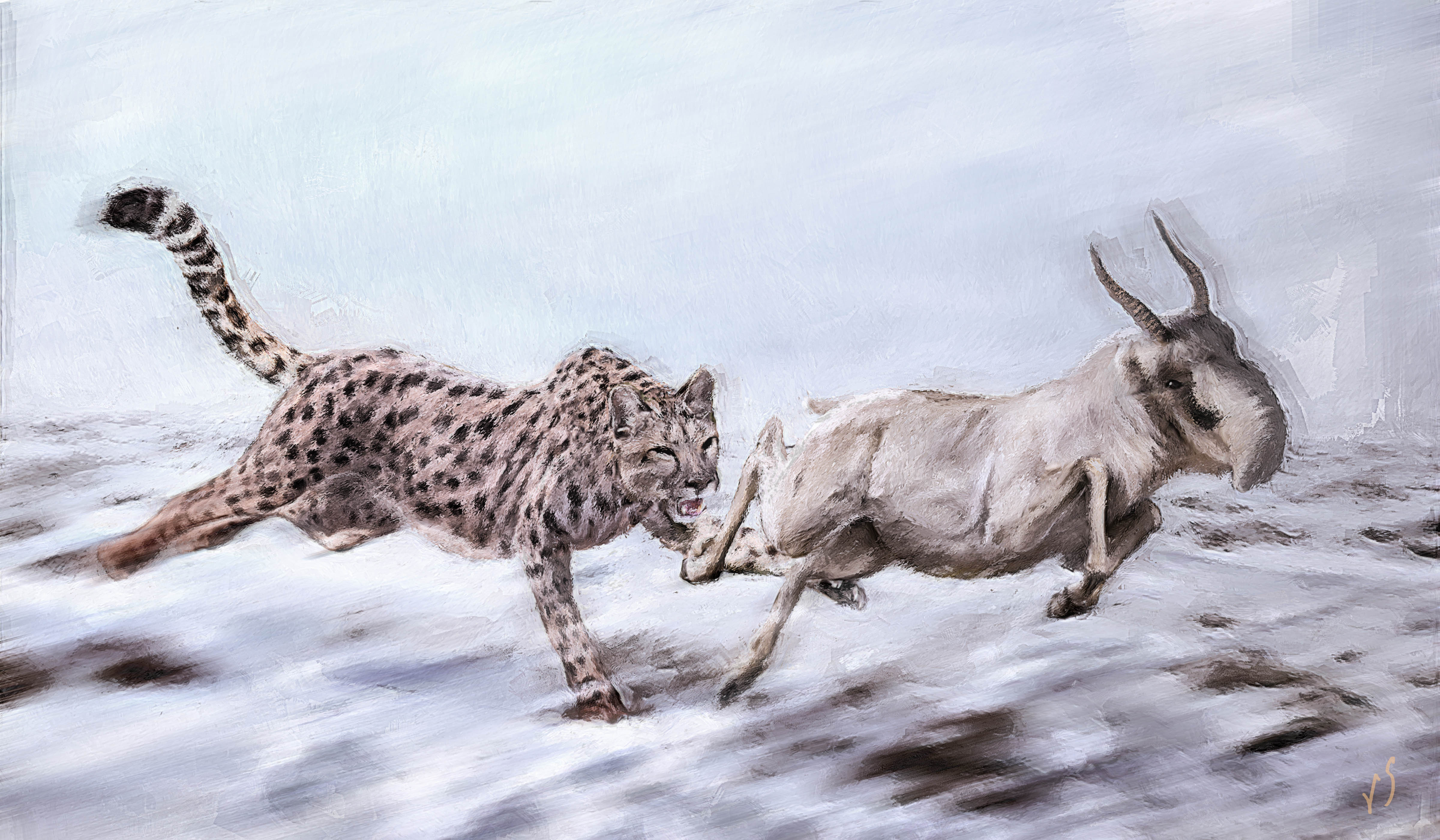
A depiction of Miracinonyx trumani racing after its pray. Illustration by Velizar Simeonovski.
Cracks in the cheetah story
The first cracks were anatomical. As Molly described, fossils found in the Grand Canyon in the 1930s were later reassigned to Miracinonyx, which was surprising, since there is little open ground to sprint across in a canyon. An animal living there would have been climbing dry uplands and cliffs after bighorn, closer to the ambush hunting of a snow leopard than the pursuit of a cheetah. Later morphology work pointed the same way. Studies on the elbow-joint shape, a useful indicator of hunting style, placed Miracinonyx between the puma and the cheetah [2], while a study of wrist bones grouped it with the large pantherine cats [3]. As our TikTalk speaker Molly argues, these cats probably kept an intermediate lifestyle, able to grapple and climb while still carrying some sprinter’s anatomy, occupying a niche with no clear modern equivalent.
What the genome revealed
Early hypotheses placed Miracinonyx as a close relative to the African cheetah, but in 2005 Ross Barnett et al. analyzed mitochondrial DNA fragments that instead made it closest to the puma [4]. Because cats are known for mismatches between their mitochondrial and nuclear genomes, in her recently published work Molly aimed to test such evolutionary origin with nuclear genomes [5]. Her own project began with three fossils from Yukon, Canada, labelled as pumas and dated to around 30,000 years ago. The first phylogeny looked nothing like a puma, and her initial assumption was that she had made an error. A fourth sample though, confirmed as Miracinonyx from Natural Trap Cave in Wyoming and dated to about 23,000 years ago, clustered with all three Yukon “pumas”. Sequencing the two best samples to high coverage confirmed that Miracinonyx was indeed a sister species to the puma, with both lineages splitting around 2.6 million years ago [5]. This is also the most evident explanation, since a cheetah relationship would have required an awkward back-dispersal across continents.
A cat at two ends of a continent
The Yukon fossils extended Miracinonyx’s known range far to the north. The earlier record tied this species to the grasslands of the temperate North America, where pronghorn lived [6], but Molly’s Beringian samples came from far northern regions. Furthermore, stable isotopes extracted from these bones were able to explain what they ate, and the answer was unexpected. The Wyoming samples resembled other Pleistocene carnivores, but the three Yukon samples sat far away from any other profile of Ice Age carnivore measured. Compared against modern salmon-eating brown bears, marine-feeding “sea wolves” of coastal British Columbia, and fish-eating orcas, the Yukon Miracinonyx looked like having a diet made up almost entirely of aquatic resources [5]. The same species appeared to be both a grassland hunter at one end of its range and a fish specialist at the other. Besides, their genomes showed low diversity, close to African cheetahs and inbred Florida panthers, but spread evenly across the genome, a signature revealing a small population held steadily over a long time rather than a sudden population bottleneck. Indeed, effective population size modeling confirmed a slow, sustained decline into the late Pleistocene [5].
Why reading species on their own terms matters
The thread running through Molly’s talk is a caution about analogy. We picture extinct animals by comparing them to living ones, and the risk is that the comparison becomes the conclusion, reducing the animal to a copy of whatever it resembles nowadays. For decades a cheetah-shaped cat was assumed to have lived a cheetah’s life. What emerged instead was a puma relative with wide ecological range up to the Arctic, where aquatic hunting became the way to survive. As Molly put it, interpreting the past through the lens of the present can strip an animal of its real dimensionality, which is precisely why her data is so valuable. A shared body shape is not a shared way of life.
References
- Adams, D. B. The cheetah: Native American. Science (1979). 205, 1155–1158 (1979).
- Figueirido, B. et al. Elbow-joint morphology in the North American ‘cheetah-like’ cat Miracinonyx trumani. Biol Lett 19, (2023).
- Dunn, R. H., Cooper, C., Lemert, J., Mironov, N. & Meachen, J. A. Locomotor correlates of the scapholunar of living and extinct carnivorans. J Morphol 280, 1197–1206 (2019).
- Barnett, R. et al. Evolution of the extinct Sabretooths and the American cheetah-like cat. Curr Biol 15, (2005).
- Cassatt-Johnstone, M. et al. Range and diet diversity in the Pleistocene American “cheetah,” Miracinonyx trumani. Curr Biol S0960-9822(26)01003-1 (2026).
- Van Valkenburgh, B., Grady, F. & Kurtén, B. The Plio-Pleistocene cheetah-like cat Miracinonyx inexpectatus of North America. J Vertebr Paleontol 10, 434–454 (1990).
Below, Molly shared with us further details about her profile, career, prospects and future projects:
1. Briefly introduce yourself. What is your origin story for how you got into science?
I did my undergraduate degree in Cognitive Science, thinking I would perhaps pursue clinical research or work in science communication and education. However, my final quarter of my undergraduate degree I took a field course with Dr. Beth Shapiro that reshaped my career intentions. The course led to a summer internship in her lab, which conveniently helped me sort out what it meant to be a college graduate and start a career. I had no prior experience with molecular biology, aside from general intro biology classes, so the internship was a very steep learning curve. I realized I loved the challenge of learning all this new science in a very applied manner. I was subsequently offered a full-time technician position where I could continue to build the foundational knowledge I had been missing in molecular biology while exploring how this information can be used to answer evolutionary questions. I’d always thought I liked ecology, but during that internship I realized the questions I was interested in were actually all evolutionary.
2. How and/or why did you start working on this project?
This project was actually started with three fossils from the Yukon, Canada that had been sent to Dr. Shapiro’s lab as part of a different student’s dissertation project. The fossils were originally identified as pumas, all dated to around 30,000 years ago. These samples would have been paramount for understanding the evolutionary history of pumas in North America, as they predate the coalescent time of all North American puma lineages. However, when we first screened the samples and realized they sat far outside any known puma mitochondrial diversity, the PhD student whose project it had been didn’t have the time to take this on, so I was lucky enough to get handed this as a project and got to see it through from the first surprising result to the end, and the results have finally been published!
3. Were there any major challenges in this project? How did you overcome them?
Definitely. For the first several years, we only had the Yukon samples, and while confirming they represented something far outside known puma diversity was exciting, I struggled with how to build that into a compelling scientific story. It was easy enough to generate nuclear genomic data and document a range extension into Beringia, but for a while, the narrative gap was the biggest obstacle. I had an interesting discovery without a clear sense of the larger story it was telling. Thankfully, that changed when we gained access to the Natural Trap Cave samples. Having a second population to compare against transformed the project, where instead of describing one isolated, unusual specimen, I could start asking comparative questions, which really helped to frame the manuscript into what I think is a much more compelling paper.
4. What do you think are the main take-home messages of this project?
The take-home message for me was that Miracinonyx trumani wasn’t behaving as a single predator across its range; instead, we see evidence in Beringia that they were using a strikingly different ecological strategy than we’d expect from a cursorial, cheetah-like hunter. We see this kind of ecological flexibility constantly in modern carnivores but it’s easy, at least for me, to forget that extinct species were capable of the same behavioral and ecological plasticity. There’s a natural tendency to flatten extinct animals into a single fixed caricature, in part because the fossil record so often gives us just one snapshot to work with. This project was a reminder that we owe extinct species the same dynamism and variability we readily accept in extant species. That’s also why multi-proxy approaches and strong collaborations are so important. A single data type will always struggle to capture the total complexity of an organism, living or extinct.
5. What do you think is missing in the field that you would like to work on?
What a big question! I think we’re seeing a lot more temporal genomics recently, using historical or museum specimens to add in a pre-Anthropocene baseline to conservation genomics studies. I also think temporal sampling has real, underused potential to reduce the burden we place on wild and threatened populations. I’m excited to work within that sector, answering conservation questions while minimizing invasive approaches. As wet lab and sequencing costs continue to drop, figuring out how to further reduce the cost, both in resources and in harm to wild populations, is something I think is very valuable to the field.
6. Where do you see yourself in the near future?
I’m working toward finishing my PhD, so the future I’m envisioning is a little uncertain! I am trying to envision having a very stress-free and completely relaxed defense, and then starting the next adventure, whatever that may be! I definitely see a lot of applications in my future, so I’m very open to anyone who’s interested in collaborating or furthering opportunities!
7. Free space to tell something you would like to remark.
Thanks so much for having me! Excited to be a part of this community!